
On May 21, 1883, a violent spring storm battered the Chicago coastline. The wind howled, and waves slammed against the lakefront barriers so hard that spray shot over 100 feet into the air. Somewhere out in that chaos, the Wells Burt was fighting a losing battle. Today, you don’t have to look hard to find the aftermath of that night. You just have to descend 40 feet below the surface.
Diving the Great Lakes is completely different from diving a quarry or a tropical reef because you aren’t just looking at scenery—you are swimming through a frozen moment in history. The Wells Burt is one of the best examples of this sitting right in our own backyard.
A Workhorse of the Inland Seas
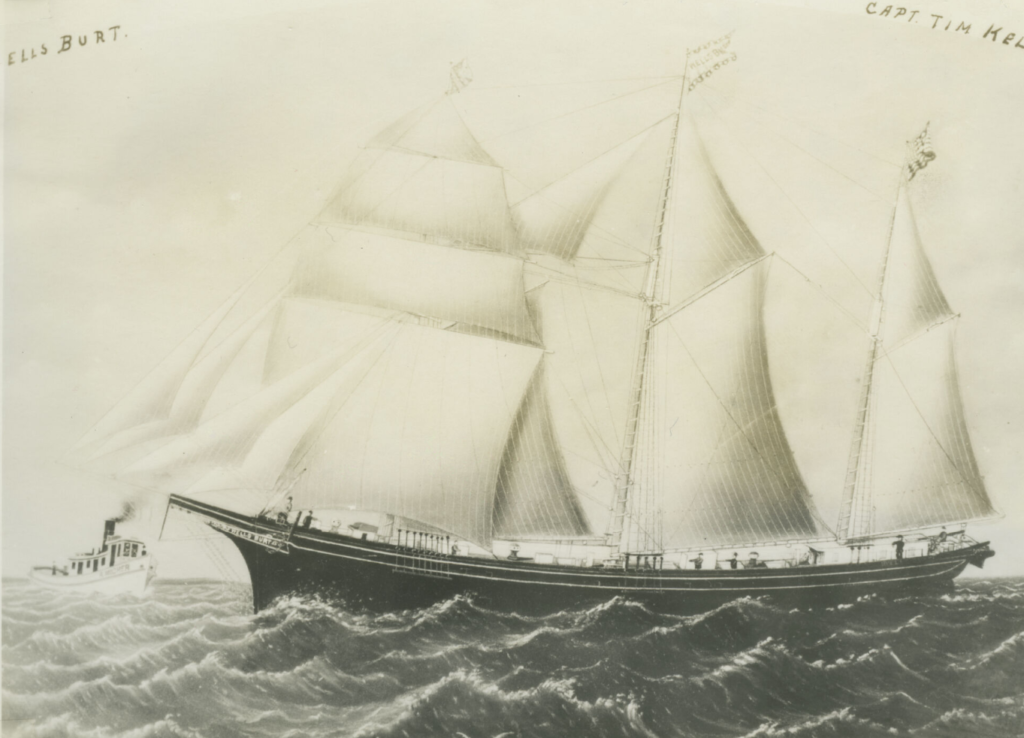
Launched in 1873 by the Detroit Dry Dock Company, the Wells Burt was a massive three-masted schooner. Measuring 201 feet long with a 33.5-foot beam, she was built as a heavy-duty bulk carrier, boasting a 14-foot hold capable of carrying 50,000 bushels of corn. She was widely considered a top-tier vessel, earning high praise for her craftsmanship.
But on the Great Lakes, even the best ships are at the mercy of the weather.
The Final Voyage
In May of 1883, the Wells Burt was en route from Buffalo to Chicago, loaded down with 1,540 tons of anthracite coal. When the furious storm hit, the savage weather disabled her steering gear, leaving the massive schooner completely unmanageable in the heavy seas. She broached, swamped, and sank to the bottom.
Tragically, all 11 crew members perished that night, including Captain Thomas Fountain and his son. Shortly after the storm, commercial divers hired by the ship’s owner assessed the wreck. They salvaged her masts and anchors, but determined that raising the ship was impossible because she had already sunk deep into the soft clay bottom. Having lost her commercial value, the Wells Burt was abandoned and largely forgotten.
Diving the Wreck Today
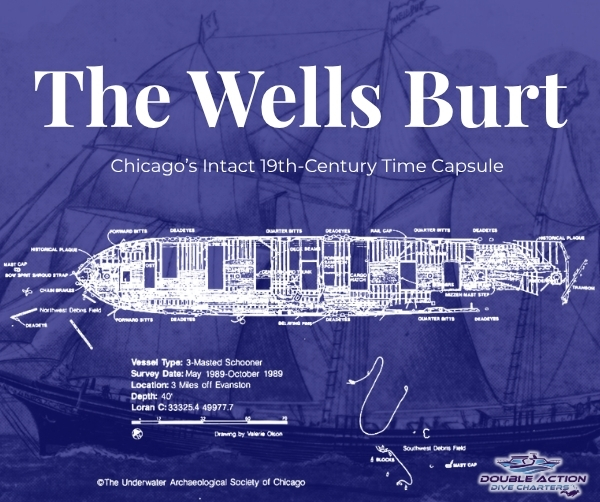
It took over a century for the Wells Burt to be rediscovered. In the fall of 1988, professional divers running sonar on a fishing trip finally found her resting three miles off the coast of Evanston, Illinois. The Underwater Archaeological Society of Chicago (UASC) surveyed the site in 1989, revealing something incredible: unlike many Chicago-area shipwrecks, she was almost completely intact.
Today, she serves as a fantastic, accessible dive site, especially for newer divers looking to build their Great Lakes experience.
When you dive the Wells Burt with us, you are exploring a ship that has settled about eight feet into the clay, resting on her port bilge at a 30-degree angle. Because she sits in just 40 feet of water, bottom times are generous.
Swimming over the wreck, you will find two-thirds of her decking still perfectly in place, and her holds are easily accessible through the hatches. Heavy deck equipment that survived the storm is still sitting exactly where it was left over 140 years ago. You can inspect three different capstans, the anchor windlass, the massive centerboard trunk, and the centerboard winch. Look closely along the sides, and you will even see the chainplates and deadeyes still attached.
It is a true underwater museum. If you want to log some bottom time and see exactly how a 19th-century schooner was put together, check out the charter calendar for the SeaQuest II and book a trip to the Wells Burt. Just remember—like all historic wrecks, she is strictly look-but-don’t-touch. Leave the artifacts exactly where they are so the next boatload of divers can experience the same incredible history.
Image Sources
Edward J. Dowling Collection, University of Detroit-Mercy
John F. Miller
Underwater Archaeological Society of Chicago